Monday, March 31, 2008
What Are Fermented Foods?
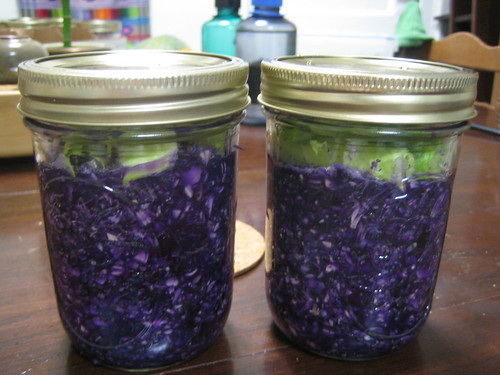
Sauerkraut ready to ferment, originally uploaded by megyn.ohara.
Fermented foods are far more common than we realize; yogurt is the most commonly eaten fermented food in the United States. Sauerkraut-another name for fermented cabbage - is an example of a cultured vegetable. An Asian version of fermented cabbage, particularly popular in Korea, is called kim chee. A basic fermentation process is used to culture the cabbage in kim chee, and chili pepper, garlic, and salt are typically added to give this cultured vegetable its pungent character.
During the fermentation process, friendly bacteria both enrich and preserve the food. Lacto-fermentation neutralizes enzyme inhibitors and breaks down the glutens, sugars, and other elements that are otherwise difficult to digest. These friendly bacteria are beneficial for the digestion, increase the availability of vitamins, and promote the growth of healthy flora throughout the digestive tract.
Because bacteria and other micro-organisms exist everywhere in our environment, and because all of the foods we eat can serve as food for bacteria as well, most foods - including vegetables - will naturally ferment. Some websites encourage the use of natural fermentation as a way to increase the value of vegetables. In this context, "natural fermentation" means leaving the vegetables in a container at room temperature for 4-7 days. No additional bacteria are added to the vegetables, and no heating process is used.
Labels: bacteria, digestion, fermented, flora, healthy diet, kimchi, sauerkraut, yogurt


Thursday, January 10, 2008
Probiotic - SHOPPING TIPS
Some manufacturers do a better job of delivering viable microbes (identified on the label as CFU, short for colony-forming units) than others. Gary Huffnagle, PhD, a professor at the University of Michigan Medical Center, recommends Align, Culturelle, Florastor, Jarrow, and Theralac.
FREEZE-DRIED
Freeze-drying, which removes all water from the microbes, makes them more likely to survive in pill form. When you take the supplement, the fluid in your digestive tract reanimates the bacteria.
REFRIGERATED
Although some high-quality supplements don't require refrigeration, most do. Lower temperatures increase the length of time microbes can survive.
MULTIPLE STRAINS
Look for a supplement that contains different species of bacteria, such as Lactobacillus and Bifidobacteria. “You want a variety in your probiotics just as you want variety in your diet,” says nutritionist Elizabeth Lipski, PhD, CCN, author of Digestive Wellness (McGraw-Hill, 1995). And look for a different formulation the next time you shop for supplements. “I generally have people take one supplement for a while and then switch so they get exposed to a wide range of benefits.”
OTHER INGREDIENTS
Because probiotics need food as soon as they reanimate, a supplement that contains a prebiotic, such as inulin, can improve the flora's chances of surviving in your digestive system.
DOSE
“For the average, healthy person, a dose between 5-10 billion microorganisms is protective and preventive, even if you take the supplements only a few times a week. If you've been on antibiotics or are recovering from illness, aim for 30 billion,” Huffnagle recommends. Look for supplements that clearly state each dose's CFU. Avoid those that list ingredients only by weight.
EXPIRATION DATE
Because probiotics contain live microbes, they won't remain viable forever. Make sure to purchase in quantities that will enable you to finish the supplements before the expiration date.
Thanks!
Labels: digestion, flora, how-to, Probiotics, supplements
