Thursday, July 09, 2009
Why We Need Detox
 Dr. Alejandro Junger: There is another “inconvenient truth” still hidden from popular awareness. Global warming is just a symptom. At the root of it is global toxicity, the build-up of chemicals that is threatening all life on earth.
 The air we breathe, the water we drink and shower with, the buildings we live and work in, and most of all, the foods we eat, are loaded with chemicals that alone or in combination cause irritation, inflammation, sickness and, ultimately, death.
Preservatives, conservatives, additives for color, smell, taste and texture, pesticides, insecticides, fertilizers, herbicides, fungicides, hormones, antibiotics, wax, chlorine, mercury, lead, arsenic, fluoride, polyhydrocarbons, DDT, PCB’s, phthalates, PBA, saturated fats, trans fats, MSG, detergent and thousands of new chemicals are released every year, with thousands more awaiting FDA approval.
The human body comes equipped with a highly effective detox system, a team of organs working together to eliminate the toxic waste of normal metabolism, such as uric acid, lactic acid, carbon dioxide, ammonia and homocysteine. Somehow it can even detoxify most of the modern chemicals. The problem is that when the detox organs get overwhelmed, toxins continue circulating and cause inflammation. As a defense, the body generates mucus to coat toxins and trap them in the tissues where they remain when digestion is kept working day in, day out. If they persist over time, toxin and mucus accumulation can cause increased acidity, malfunction and eventually the collapse of all systems, one by one.
Global toxicity is enough to overflow the body’s detox capacity. Modern habits worsen the problem by keeping the detox process slow. All the different organs of the body need energy to function. Energy distribution has to be prioritized when many systems are being used at the same time or there won’t be enough. The body still gives priority to digestion over detox. For centuries, food was hard to come by. Only recently in evolution do we have food available and eat it 24/7, but our genes still act as if each feeding is the last meal and slow down everything else to concentrate on food. With digestion a full-time job, detox has to wait its turn while toxins keep coming in.
Modern medicine is detox-blind. Even though this information could save your life, there are no medical specialists dedicated to detect and treat the effects of global toxicity.
Labels: detox, detoxification, digestion, healthy diet, toxic metals, toxins


Wednesday, July 01, 2009
Know Your Probiotics
 Probiotic strains differ in many ways:
Acid and bile resistance
Many probiotics are not able to survive the acid in the stomach and bile in the small intestine to reach the desired location in the gut (in some cases, fewer than 25% can make it through) – look for acid and bile resistant probiotics.
Colonizers vs. transients
Many probiotics are not able to colonize in the gut, they provide health benefits only on their way through the gut. Colonizers multiply and continue to provide benefits when they reach their destination. This is one of the reasons that some probiotics start with very large numbers of bacteria (often less than 25% even make it to the gut) and then the benefits are very transient. Colonizers can multiply from 100 to 200-fold so 5 billion will become 500 billion or more.
Production of enzymes
Some probiotics are able to produce enzymes that aid in digestion – proteases, lipases, amylases, cellulase and lactase. Natural production of digestive enzymes declines with age so it helps to have the microflora produce additional enzymes.
Production of vitamins
Some probiotics are able to produce vitamins to help the user meet nutritional needs. This is particularly important with vitamin B12 since we lose the ability to absorb B12 as we age.
Production of natural antibiotics
Some probiotics can produce other helpful substances like bacteriocins that reduce numbers of harmful bacteria (one example is acidophilin produced by Lactobacillus acidophilus DDS-1). Certain strains (like DDS-1) can produce hydrogen peroxide that helps to reduce Candida albicans (responsible for yeast overgrowth).
Labels: bacteria, digestion, digestive enzymes, healthy eating, Holistic Health, nutritional information, Probiotics, vitamin B12
Wednesday, May 20, 2009
Mood and Food
 Just like what you eat can influence how you feel, how you feel can influence the quality of nourishment that you gain from the foods that you eat. The following are some of the ways in which mood and nourishment are interrelated.
 When you feel stressed a cascade of different stress hormones (including glucocorticoids) can be released. These chemical messengers have modulating effects upon a variety of body systems that can impact nourishment. All of us feel stressed at certain moments, but if this stress has become an ongoing, chronic part of our life, the impact on our nourishment can become problematic.
Nutrient depletion and blood sugar regulation
One of the outcomes of chronically increased glucocorticoid levels is potential depletion of certain nutrients, including zinc, potassium, and B-complex vitamins. What this means is that if you experience chronic stress, you will want to pay special attention to these nutrients in your diet. Stress hormones, if excessively secreted over a prolonged period of time, can interfere with the functioning of insulin and promote insulin resistance. Stress can create blood sugar imbalances that have a host of outcomes upon the body, including reducing the ability of cells to be nourished by the glucose provided in the diet.
Having low moods, or experiencing depression, may also impact nourishment. Chronic depression is associated with a variety of nutrient deficiencies, including that of vitamin B6, vitamin B12, folate, choline, protein, and omega-3 fatty acids. A person experiencing ongoing depression would want to take special steps to adjust his or her meal plan in relationship to these particular nutrients.
Benefits of a relaxing mealIn addition to looking at how mood affects nourishment from a biochemical perspective, you can also look at this question from the perspective of personal experience. Think about a recent meal that you ate while being stressed, angry, or anxious. Now think about a meal that you ate when you were relaxed, peaceful, and happy. Chances are in the latter experience you felt better, more vitalized, and more nourished from the foods you were eating and were therefore enjoying the true fulfillment and nourishment from those foods. Remember that your mood is something you don't just experience on an emotional and psychological level, but something that also takes places in your muscles, nervous system, and circulatory system. All of those body components impact your digestion and nourishment.
Labels: depression, digestion, food and mood, Holistic Health, insulin, living holistically, nutrients, stress
Monday, May 18, 2009
Heal Your Digestion With Ayurveda
 Ayurvedic medicine is designed to restore body balance so the body can heal itself without dependence on pills or powders. In Ayurveda there is a classic remedy for the digestive process called Trikatu. Trikatu actually resets the ability for you to digest your own food rather then do the digesting for you. It is a simple combination of Ginger, Black Pepper and Long Pepper:
- Ginger is perhaps one of the worlds finest digestive aids that won't overheat the digestive process.
- Black Pepper stimulates the flow of your own digestive enzymes.
- Long Pepper helps to strengthen the digestion and break down hard to digest foods - and like ginger it won't overheat the digestive process.
Please Note: If you have a tendency towards heart burn or acid reflux, you may benefit more from the herbal formula Cool Digest, which also strengthens digestion but cools cools acidity and heat in the upper digestive tract.
While there is a time and place for digestive enzymes as a medicine for short term use to help your digestion in an emergency, long term use is just not in your best interest. Regular use of digestive enzymes weakens your digestion because your body no longer has to do the work itself and you will then become dependent on them. It's similar to exercise - if you stop exercising you start to atrophy and become weak.
Source
Labels: ayurveda, digestion, digestive enzymes, ginger, herbs, pepper, Trikatu, zymes
Wednesday, April 15, 2009
What Enzymes Can Do for You
 Your body's enzyme production drops off after you hit age 30, foods high in fat and carbohydrates become more difficult to digest — potentially leaving you with bloating, constipation, or diarrhea.
 Taking enzyme supplements regularly (or eating enzyme-rich foods like pineapple) helps break down foods so that nutrients can be absorbed. They can also help ease symptoms of lactose or gluten intolerance. Never take enzymes, though, if you have open stomach ulcers — the results can be painful.
When buying supplements for digestion, look for plant-based products that combine several enzymes — they are more likely to work across the gastrointestinal tracts' broad range of pH levels. And be sure to take the pills with food; try them with two meals a day for at least three months; after that, you may be able to go with your gut and cut back.
Look for combos of the following enzymes:
| ENZYME | HELPS DIGEST |
|---|---|
| Amylase | → Starch |
| Cellulase | → Cellulose from plant foods |
| Lipase | → Fats |
| Lactase | → Lactose in dairy |
| Phytase | → Grains and legumes |
| Protease (bromelain) | → Protein |
| Sucrase and maltase | → Complex sugars |
Source
Labels: bloating, digestion, digestive enzymes, eating healthy, enzymes, living holistically, supplements
Friday, April 03, 2009
How to Improve Digestion and Stop Gas
 Some of us seem to think that we can be healthy by simply eating healthy foods. The truth is, your health is determined by how well you digest the foods that you put into your body. In other words, you might be eating an unprocessed, whole food diet, but if your digestive passageway isn’t effectively breaking these foods down and absorbing nutrients, you are not giving yourself a chance to come close to your best health.
What does this have to do with farting? The amount you fart is one of the best indicators of how well you are digesting your food. Farting is in part due to rotting of incompletely digested foods in your digestive passageway. Farting in itself is actually helpful, as it represents unwanted gas leaving your body. In fact, if you have an urge to fart, be sure to do so. The point is, if you are farting a lot, then you probably have a lot of toxin formation occurring inside your gut from rotting of incompletely digested food, and some of these toxins are entering your blood stream and contributing to the development of long term disease. Farts that do not produce objectionable odor are usually pockets of air that you have swallowed.
So, what can you do to improve your digestion and prevent toxin formation from rotting of undigested food in your gut?
1. Chew your food until liquid. You don’t have teeth anywhere else in your digestive passageway. By chewing your food until liquid, you allow your digestive organs to do their jobs efficiently without the burden of having to break down larger chunks of food. If you don’t remember anything else from this newsletter, please remember this one point. It can make a huge difference in your level of health.
2. Consistently eat whole, unprocessed foods. An apple is better than apple juice. A bowl of oatmeal is better than a power bar. An organic egg is better than any egg substitute. And organic butter is much better than margarine. The closer your foods look like they can be found in a garden, in the wild, or on an organic farm, the greater chance your body has of efficiently digesting them.
3. Avoid foods that experience tells you no matter how well you chew, your body just says no. Based on your genetics and health status, there are foods that your body will digest beautifully, and there are foods that your body simply cannot break down. It’s your job to observe how you feel after each meal to identify these foods. It is important to note that as your health changes over time, your tolerance for different foods may also change, so you don’t need to write off a particular food forever if it isn’t working for you right now.
4. Don’t eat fruit for dessert. Fruits are extremely low in protein compared to all other foods, including vegetables. And all foods that have significant protein must spend about an hour to an hour and a half in your stomach, where the protein is broken down by acid produced by your stomach. If fruit gets caught up in your stomach because there are other foods churning there already, it is possible that some of the fruit will rot, resulting in gas and toxin formation. Try to eat fruit on an empty stomach, or about two hours after a big meal.
5. Take it easy for at least 30 minutes after a big meal. In order for your digestive organs to effectively break down food, they need to receive a large portion of your total blood volume after a big meal. If most of your blood is flowing to your muscles because you are running around, you’re not going to have enough available for your digestive organs to do good work.
Use the amount that you fart as a marker for your digestive strength and the health of your gut. By following the steps outlined above, you should see a dramatic reduction in gas production.
Labels: digestion, farting, farts, fruit, healthy diet, processed foods, Whole Foods
Friday, March 13, 2009
Choose the Right Probiotic
| STRAIN | TARGETS | HOW IT WORKS | PRODUCT PICK | HOW MUCH? |
|---|---|---|---|---|
| Acidophilus CL 1285 | Overall digestion | Balances gut flora | Bio K+CL 1285 Original Fermented Milk | Contains 100 billion CFUs* per 3.5-oz. bottle. Drink 1/4-1 bottle/day. |
| L. acidophilus DDS-1 | Stomach cramps and gas triggered by lactose intolerance | Produces enzyme lactase and hydrogen peroxide | Natren Mega Vegi-Dophilus | Contains 2 billion CFUs per teaspoon. Start with 1/8 tsp/day and increase to 1 tsp/day. |
| L. rhamnosus GG | Immune system | Balances gut flora; inhibits growth of harmful bacteria | Culturelle | Contains 10 billion CFUs per capsule. Take one daily. |
| L. rhamnosus GR-1 and L. fermentum RC-14 | Vaginal yeast infections | Inhibits bacteria growth and yeast | Jarrow Fem-Dophilus | Contains 5 billion CFUs per capsule. Take one daily; increase to 2/day as needed. |
| L. plantarum 299v | Pain and constipation associated with IBS | Balances gut flora | Good Belly Multi-Probiotic Fruit Drink | Contains 20 billion CFUs per 2.7-oz. container. Drink one daily. |
| Saccharomyces boulardii | Antibiotic-provoked diarrhea | Balances gut flora | Florastor | Contains 5 billion CFUs per capsule. Take 6/day. |
| *Colony forming units Source | ||||
Labels: bacteria, digestion, healthy living, Holistic Health, Probiotics
Wednesday, February 18, 2009
What You Should Eat to Encourage Sleep
 Not too much! It is important that your body be able to focus on rest and repair while you sleep, rather than on digestion. It is more important to gear your evening meal towards relaxation and good digestion than to consume any particular food or drink before bed.
Your evening meal should:
- emphasize low-to-medium glycemic index carbohydrates, such as whole-grain breads, rice, or pasta, yams, a mixed green salad, or lightly sautéed vegetables
- include a small portion of a healthy fat-containing food, such as olive oil, avocado, or nuts or seeds or their oils or butters
- include herb tea (especially chamomile or peppermint) or other non-stimulating water-based beverage
- include only fresh, dried, or cooked fruit for dessert, if dessert is desired.
Your evening meal should be eaten about 4 hours before bedtime so that the main digestive effort is finished, but the energy from these foods can be released gradually throughout the night. If it is necessary for you to eat a snack at bedtime, choose one or two of the following:
- small cup of herb tea or warm milk (soy, nut, or dairy)-not so much that you must wake up to use the restroom in the middle of the night
- small serving of fresh or dried fruit
- small handful of raw nuts or seeds
Labels: digestion, herbal teas, living holistically, sleep
Thursday, December 11, 2008
Is Apple Cider Vinegar a Magic Food?
 When thinking about apple cider vinegar and its potential benefits, it's important to keep in mind that it is not a whole food, but rather a liquid derived from processing. While vinegar can be both delicious and nourishing, it is still not possible to consider it as a whole food.
 High acidity
First and foremost, vinegar is usually highly acidic. The acidity of vinegar is typically related to its acetic acid content, and this content can vary fairly widely from vinegar to vinegar. For some individuals, especially those with stomach or digestive problems including acid reflux, vinegar might not be a desirable food component to include in their meal plan because it can serve as an irritant. I've seen some websites that recommend use of vinegar precisely because of its acidity. These websites suggest that vinegar can be used to help offset problems with acid deficiency in the stomach or other digestive problems. I'm not aware of any scientific research that supports this recommendation.
Claimed benefit - blood sugar control
First, there are some studies linking vinegar to improved control of blood sugar following a test meal. About half of the limited studies in this area have been conducted on genetically modified rats and do not provide any immediately helpful information about humans and the way we eat everyday. The human studies in this area tend to focus on delivery of a test food or test meal-typically highly processed and devoid of any whole, natural foods-that has been augmented with a dose of vinegar. While these studies do show a trend toward improvement in blood sugar response in the range of 2-20%, it seems reasonable to assume that a key problem here is the poor quality of the test foods and test meals.
Several authors have mentioned delayed stomach emptying as a likely mechanism for the impact of added vinegar on blood sugar response. If that hunch turns out to be correct, the idea of poor quality foods makes even more sense. Our stomach tends to empty too quickly if it is filled with highly processed, low-nutrient, fiber-free foods. I would expect whole, natural foods with excellent fiber content and nutrient variety to be more effective in improving blood sugar control than vinegar added to a meal that is composed of poor quality foods.
Claimed benefit - enhanced calcium absorption
Second is the area of calcium absorption. This area has only been explored in animal studies so far, and both the doses and experimental conditions have been limited and difficult to match up with everyday consumption of vinegar on a salad or in a marinade. But the results of these studies showed the vinegar to increase the solubility of calcium within the intestinal tract of the test animals and to increase absorption in this way. Once again, I would question the value of these rat experiments for decision-making about whole, natural foods. From my perspective, the degree of calcium solubility in whole, natural foods that are properly handled and properly cooked is exactly what it should be.
Some websites tout the nutritional benefits of apple cider vinegar from a mineral standpoint. Based on nutrient database values, the amount of minerals in a tablespoon of this food is very, very limited and cannot be thought of as a significant contribution to any diet.
SourceLabels: Alpha Lipoic Acid, apple cider vinegar, calcium, digestion, world's healthiest foods
Monday, November 24, 2008
Yoga to Help You Digest
 1-Legged Seated Spinal Twist can help get things moving in your belly. It's also a great pose to do after sitting for a long period of time. Bend one knee and cross your opposite elbow over to the outside edge of your knee and look over your back shoulder. As you breathe, continue to deepen the twist. Stay here for five breaths or more, then do the other side.
If you're bloated, having gas pains, or are constipated, bend both knees into your chest and give yourself a big hug. This is affectionately called Wind-Relieving Pose, if you catch my drift. It'll help to massage your abdominal organs.
Another great stretch for digestion is Wide-Legged Forward Bend. This is great at helping relieve gas pains and that uncomfortable bloated feeling.
This is a pretty intense stretch when it comes to aiding digestion so ease into this one called Wide Squat. If you're bloated, this pose can bring relief, but you may want to do this in private.
Thanks!
Labels: benefits of yoga, bloating, digestion, gas, yoga
Monday, March 31, 2008
What Are Fermented Foods?
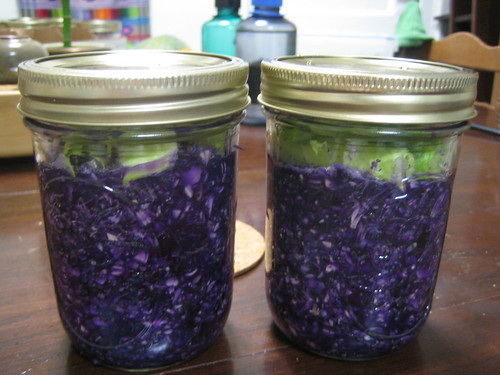
Sauerkraut ready to ferment, originally uploaded by megyn.ohara.
Fermented foods are far more common than we realize; yogurt is the most commonly eaten fermented food in the United States. Sauerkraut-another name for fermented cabbage - is an example of a cultured vegetable. An Asian version of fermented cabbage, particularly popular in Korea, is called kim chee. A basic fermentation process is used to culture the cabbage in kim chee, and chili pepper, garlic, and salt are typically added to give this cultured vegetable its pungent character.
During the fermentation process, friendly bacteria both enrich and preserve the food. Lacto-fermentation neutralizes enzyme inhibitors and breaks down the glutens, sugars, and other elements that are otherwise difficult to digest. These friendly bacteria are beneficial for the digestion, increase the availability of vitamins, and promote the growth of healthy flora throughout the digestive tract.
Because bacteria and other micro-organisms exist everywhere in our environment, and because all of the foods we eat can serve as food for bacteria as well, most foods - including vegetables - will naturally ferment. Some websites encourage the use of natural fermentation as a way to increase the value of vegetables. In this context, "natural fermentation" means leaving the vegetables in a container at room temperature for 4-7 days. No additional bacteria are added to the vegetables, and no heating process is used.
Labels: bacteria, digestion, fermented, flora, healthy diet, kimchi, sauerkraut, yogurt
Wednesday, March 05, 2008
Fiber - Why Do We Need It?
 Dr. Oz says the positive effects of getting enough fiber will happen "almost immediately." The fiber can help move things through your system—including toxins—very quickly. And that's not all. "Bile, when it gets absorbed through the bowel, turns into cholesterol. So when you take a lot of fiber in your diet, you suck the bile out of you, and your cholesterol drops automatically. It also gets rid of sugar, which helps the diabetics. And it's a great tool if you want to lose weight because it makes you feel full."
Do you need to get more fiber in your diet? Most likely, Dr. Oz says. The average American gets just seven grams of fiber a day. But women need about 25 grams a day, and men need 35 grams a day. "That's somewhere between seven and nine helpings of fruits and vegetables," he says.
If you radically increase your intake of fiber, though, you may feel gassy. "Your intestinal tract isn't ready for it," Dr. Oz says. "The fiber in the bowel is permeated by all these bacteria, the bacteria eat the fiber, and they make gas. That's their waste product. So you've got to slowly build up when you add fiber to your diet. But at the end of the day, you're going to have some gas. But it's a good sign because you're digesting food that's good for you."
Source
Labels: digestion, Dr. Oz, fiber, healthy diet, healthy eating, Oprah
Thursday, January 10, 2008
Probiotic - SHOPPING TIPS
Some manufacturers do a better job of delivering viable microbes (identified on the label as CFU, short for colony-forming units) than others. Gary Huffnagle, PhD, a professor at the University of Michigan Medical Center, recommends Align, Culturelle, Florastor, Jarrow, and Theralac.
FREEZE-DRIED
Freeze-drying, which removes all water from the microbes, makes them more likely to survive in pill form. When you take the supplement, the fluid in your digestive tract reanimates the bacteria.
REFRIGERATED
Although some high-quality supplements don't require refrigeration, most do. Lower temperatures increase the length of time microbes can survive.
MULTIPLE STRAINS
Look for a supplement that contains different species of bacteria, such as Lactobacillus and Bifidobacteria. “You want a variety in your probiotics just as you want variety in your diet,” says nutritionist Elizabeth Lipski, PhD, CCN, author of Digestive Wellness (McGraw-Hill, 1995). And look for a different formulation the next time you shop for supplements. “I generally have people take one supplement for a while and then switch so they get exposed to a wide range of benefits.”
OTHER INGREDIENTS
Because probiotics need food as soon as they reanimate, a supplement that contains a prebiotic, such as inulin, can improve the flora's chances of surviving in your digestive system.
DOSE
“For the average, healthy person, a dose between 5-10 billion microorganisms is protective and preventive, even if you take the supplements only a few times a week. If you've been on antibiotics or are recovering from illness, aim for 30 billion,” Huffnagle recommends. Look for supplements that clearly state each dose's CFU. Avoid those that list ingredients only by weight.
EXPIRATION DATE
Because probiotics contain live microbes, they won't remain viable forever. Make sure to purchase in quantities that will enable you to finish the supplements before the expiration date.
Thanks!
Labels: digestion, flora, how-to, Probiotics, supplements
Wednesday, October 10, 2007
Make Your Life A Little Spicier!!
Here's what to stock:
-A dash of turmeric or saffron keeps stress (which diverts attention away from digestion) at bay.
-Cinnamon kills bad bacteria and lets good bacteria (that helps regulate your digestive system) grow.
-Add a drop of peppermint to tea to soothe menstrual cramps and diarrhea.
-Sweet-smelling cardamom, a staple in Indian and Middle Eastern dishes, prevents gas.
-All-star mustard seeds purify blood, neutralize toxins and monitor the digestive tract.
(No wonder Koff's Homestyle Mustard, made with turmeric, saffron, apple cider and vinegar, pleases taste buds and tummies, too.)
THANKS!
Labels: digestion, healthy living, natural health, spices
Monday, August 20, 2007
Food combining - Good, bad or Fiction?
Sometimes proper food combining just means avoiding extremes.
For example, some food combining advocates recommend eating protein alone or carbohydrates alone rather than protein and carbohydrate together. However, this goal is essentially impossible, since most vegetables, grains, nuts, seeds, and legumes contain both proteins and carbohydrates. You would have to eliminate all of the above foods from your diet in order to avoid eating protein and carbohydrates together. However, large amounts of protein (like the 80+ grams of protein that would be found in a 12-ounce steak) together with large amounts of carbohydrates (like the 40+ grams of sugar found in an 8-ounce glass of grape juice) might be a taxing combination for your digestive tract. The combination of these two foods might be harder on your digestive system than either food alone. Nonetheless, we see the basic problem here as one of going to extremes (too much protein at once and/or too much sugar at once) rather than food combining.
Large volumes of water during a meal can raise the stomach pH level. Exactly how this impacts digestion is not clear from research studies. But a person with insufficient stomach acid might have his or her digestion even further compromised by drinking large amounts of water with meals, because strong stomach acid concentrations are needed to help digest proteins and to trigger other digestive events in the small intestine. So in general, we encourage high-volume water drinking between meals rather than during meals. Advocates of food combining sometimes take this same approach to water drinking.
There is no research evidence that the practice of waiting an hour or more after eating fruit before consuming other foods is necessary or beneficial. However, many people report better overall digestion when they follow this procedure, and a good number of healthcare practitioners advocate fruit consumption separate from meals. There are a number of theories used to support this practice involving the fermentation process and how the fruit fermentation might take place at the expense of other digestive events. However, we have once again found no research evidence to indicate that fruit with meals is a predictable problem. As you can see from our website, we do include fruit as an ingredient in our recipes and find it to be delicious.
SOURCE
Labels: digestion, food combining, Myth
