Friday, November 20, 2009
New Report Claims That Many Probiotics Provide Fewer Live Cells Than Listed on Labels
 Americans are spending more and more dollars each year on probiotic supplements, or so-called “friendly” bacteria. Studies have shown that probiotics—which you might purchase in the form of yogurt, capsules, miso, beverages, or powders—can treat a host of conditions, including irritable bowel syndrome, diarrhea caused by viral infection or antibiotics, vaginal yeast infections, hypertension, the common cold, and even acne. Over the past decade, consumer sales of probiotics in the U.S. have nearly quadrupled (growing from $115 million in 1998 to $425 million in 2008), according to Nutrition Business Journal.
But, according to a report released today, many of the most popular probiotic supplements don’t contain the amount of live bacteria listed on their labels. ConsumerLab, a private company that tests health and nutritional products at independent labs across the country, found that at the time a consumer buys a probiotic, it may contain as little as 10 to 58% of the amount of viable organisms listed on the label. “It’s shocking how many products really don’t have what they claim on their labels,” says Tod Cooperman, the president of ConsumerLab. “The buyer has to be careful.”
Labels: bacteria, healthy diet, IBS, Probiotics, wellness, yogurt


Wednesday, July 01, 2009
Know Your Probiotics
 Probiotic strains differ in many ways:
Acid and bile resistance
Many probiotics are not able to survive the acid in the stomach and bile in the small intestine to reach the desired location in the gut (in some cases, fewer than 25% can make it through) – look for acid and bile resistant probiotics.
Colonizers vs. transients
Many probiotics are not able to colonize in the gut, they provide health benefits only on their way through the gut. Colonizers multiply and continue to provide benefits when they reach their destination. This is one of the reasons that some probiotics start with very large numbers of bacteria (often less than 25% even make it to the gut) and then the benefits are very transient. Colonizers can multiply from 100 to 200-fold so 5 billion will become 500 billion or more.
Production of enzymes
Some probiotics are able to produce enzymes that aid in digestion – proteases, lipases, amylases, cellulase and lactase. Natural production of digestive enzymes declines with age so it helps to have the microflora produce additional enzymes.
Production of vitamins
Some probiotics are able to produce vitamins to help the user meet nutritional needs. This is particularly important with vitamin B12 since we lose the ability to absorb B12 as we age.
Production of natural antibiotics
Some probiotics can produce other helpful substances like bacteriocins that reduce numbers of harmful bacteria (one example is acidophilin produced by Lactobacillus acidophilus DDS-1). Certain strains (like DDS-1) can produce hydrogen peroxide that helps to reduce Candida albicans (responsible for yeast overgrowth).
Labels: bacteria, digestion, digestive enzymes, healthy eating, Holistic Health, nutritional information, Probiotics, vitamin B12
Friday, March 13, 2009
Choose the Right Probiotic
| STRAIN | TARGETS | HOW IT WORKS | PRODUCT PICK | HOW MUCH? |
|---|---|---|---|---|
| Acidophilus CL 1285 | Overall digestion | Balances gut flora | Bio K+CL 1285 Original Fermented Milk | Contains 100 billion CFUs* per 3.5-oz. bottle. Drink 1/4-1 bottle/day. |
| L. acidophilus DDS-1 | Stomach cramps and gas triggered by lactose intolerance | Produces enzyme lactase and hydrogen peroxide | Natren Mega Vegi-Dophilus | Contains 2 billion CFUs per teaspoon. Start with 1/8 tsp/day and increase to 1 tsp/day. |
| L. rhamnosus GG | Immune system | Balances gut flora; inhibits growth of harmful bacteria | Culturelle | Contains 10 billion CFUs per capsule. Take one daily. |
| L. rhamnosus GR-1 and L. fermentum RC-14 | Vaginal yeast infections | Inhibits bacteria growth and yeast | Jarrow Fem-Dophilus | Contains 5 billion CFUs per capsule. Take one daily; increase to 2/day as needed. |
| L. plantarum 299v | Pain and constipation associated with IBS | Balances gut flora | Good Belly Multi-Probiotic Fruit Drink | Contains 20 billion CFUs per 2.7-oz. container. Drink one daily. |
| Saccharomyces boulardii | Antibiotic-provoked diarrhea | Balances gut flora | Florastor | Contains 5 billion CFUs per capsule. Take 6/day. |
| *Colony forming units Source | ||||
Labels: bacteria, digestion, healthy living, Holistic Health, Probiotics
Monday, October 27, 2008
What Are Prebiotics and Probiotics?

Prebiotics and Probiotics:
Prebiotics and probiotics can restore the balance of bacteria in your digestive tract. Probiotics are beneficial bacteria that can be found in various foods. When you eat probiotics, you will add these healthy bacteria to your intestinal tract. Common strains include Lactobacillis and Bifidobacterium families of bacteria.Prebiotics are non-digestible foods that make their way through our digestive system and help good bacteria grow and flourish. Prebiotics keep beneficial bacteria healthy.
Prebiotics in the Diet:
Prebiotics that feed the beneficial bacteria in your gut mostly come from carbohydrate fibers called oligosaccharides. You don't digest them, so the oligosaccharides remain in the digestive tract and stimulate the growth of beneficial bacteria. Sources of oligosaccharides include fruits, legumes, and whole grains. Fructo-oligosaccharides may be taken as a supplement or added to foods. Yogurt made with bifidobacteria contain oligosaccharides.Probiotics in the Diet:
Probiotic bacteria like lactobacilli are naturally found in fermented foods like sauerkraut and yogurt. Some foods will have added probiotics as healthy nutritional ingredients, which will be evident on the label.Source
Labels: bacteria, fermented, greek yoghurt, healthy diet, prebiotics, Probiotics
Monday, March 31, 2008
What Are Fermented Foods?
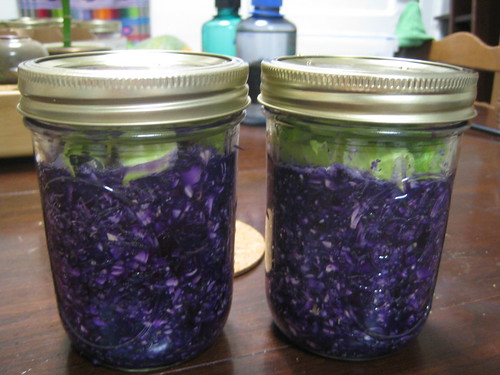
Sauerkraut ready to ferment, originally uploaded by megyn.ohara.
Fermented foods are far more common than we realize; yogurt is the most commonly eaten fermented food in the United States. Sauerkraut-another name for fermented cabbage - is an example of a cultured vegetable. An Asian version of fermented cabbage, particularly popular in Korea, is called kim chee. A basic fermentation process is used to culture the cabbage in kim chee, and chili pepper, garlic, and salt are typically added to give this cultured vegetable its pungent character.
During the fermentation process, friendly bacteria both enrich and preserve the food. Lacto-fermentation neutralizes enzyme inhibitors and breaks down the glutens, sugars, and other elements that are otherwise difficult to digest. These friendly bacteria are beneficial for the digestion, increase the availability of vitamins, and promote the growth of healthy flora throughout the digestive tract.
Because bacteria and other micro-organisms exist everywhere in our environment, and because all of the foods we eat can serve as food for bacteria as well, most foods - including vegetables - will naturally ferment. Some websites encourage the use of natural fermentation as a way to increase the value of vegetables. In this context, "natural fermentation" means leaving the vegetables in a container at room temperature for 4-7 days. No additional bacteria are added to the vegetables, and no heating process is used.
Labels: bacteria, digestion, fermented, flora, healthy diet, kimchi, sauerkraut, yogurt
