Thursday, March 26, 2009
Did You Know Sauerkraut Is VERY Good for You?
 It’s primarily known as a German staple, but most other European countries use it in their traditional dishes. It’s pretty easy to understand why it was so popular: it keeps for a long time without refrigeration. Dutch, German, and English sailors found that the vitamin C-rich kraut prevented scurvy on the open seas, and the fact that it was salted and fermented made it ideal for long voyages without other preservation methods.
 As the name would suggest, sauerkraut is quite literally sour cabbage. The sour flavor comes from the process of lacto-fermentation, similar to the pickling of cucumbers. But instead of soaking the cabbage in a vinegary brine solution, sauerkraut preparation requires only salt and the lactic acid bacteria already present on raw cabbage. More than just a delicious, tangy flavor, the beauty of sauerkraut also lies in its considerable health benefits. Besides the great vitamin C content, there’s also tons of lactobacilli, a healthy probiotic that aids in digestion and immunity. The fermentation also produces isothiocyanates, compounds shown to prevent cancer growth in animal tests. Even cabbage itself is a good source of manganese, vitamin B6 and folate.
But most of us get our kraut at the grocery store. Going that route means you’re probably losing all the good stuff through pasteurization, so why not make your own? It’s incredibly easy. All it takes is some cabbage, whatever other vegetables or fruits you’d like to include (carrots, different colored cabbage, garlic, onions, beets, even apples), a sealable storage vessel, a bit of sea salt, and patience.Read more for the recipe!
Labels: cabbage, easy recipe, health food, healthy diet, Probiotics, sauerkraut, Vitamin C


Monday, March 31, 2008
What Are Fermented Foods?
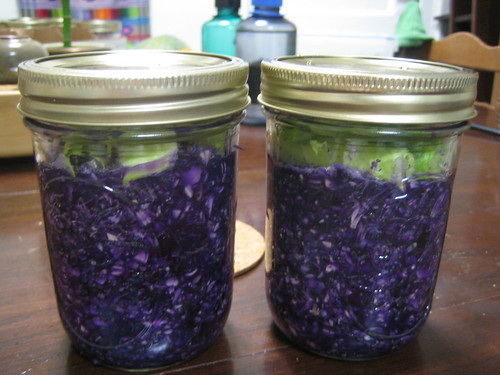
Sauerkraut ready to ferment, originally uploaded by megyn.ohara.
Fermented foods are far more common than we realize; yogurt is the most commonly eaten fermented food in the United States. Sauerkraut-another name for fermented cabbage - is an example of a cultured vegetable. An Asian version of fermented cabbage, particularly popular in Korea, is called kim chee. A basic fermentation process is used to culture the cabbage in kim chee, and chili pepper, garlic, and salt are typically added to give this cultured vegetable its pungent character.
During the fermentation process, friendly bacteria both enrich and preserve the food. Lacto-fermentation neutralizes enzyme inhibitors and breaks down the glutens, sugars, and other elements that are otherwise difficult to digest. These friendly bacteria are beneficial for the digestion, increase the availability of vitamins, and promote the growth of healthy flora throughout the digestive tract.
Because bacteria and other micro-organisms exist everywhere in our environment, and because all of the foods we eat can serve as food for bacteria as well, most foods - including vegetables - will naturally ferment. Some websites encourage the use of natural fermentation as a way to increase the value of vegetables. In this context, "natural fermentation" means leaving the vegetables in a container at room temperature for 4-7 days. No additional bacteria are added to the vegetables, and no heating process is used.
Labels: bacteria, digestion, fermented, flora, healthy diet, kimchi, sauerkraut, yogurt
